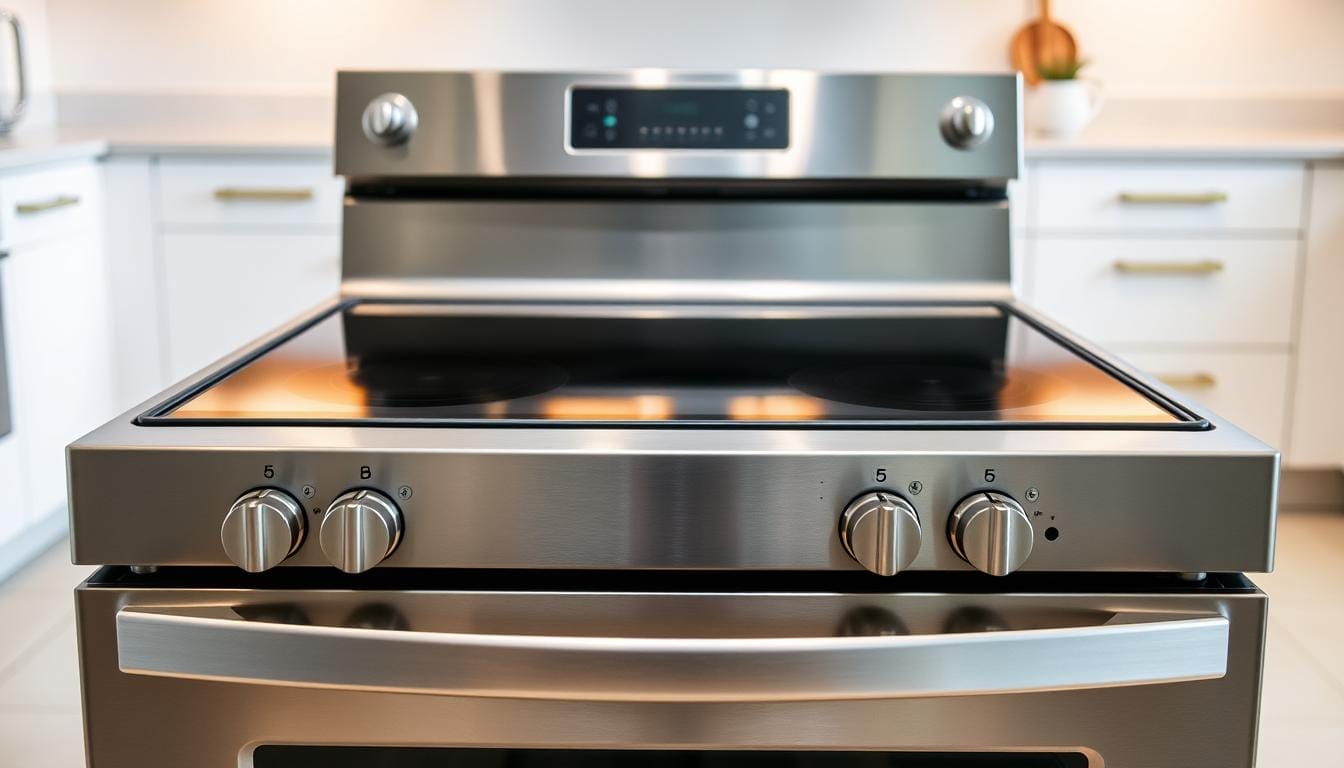
Question: Have you ever wondered which model will fit your layout, match your cooking habits, and avoid surprise installation costs?
The guide opens with practical choices: sizes (24″, 30″, 36″), oven capacity, and cooktop options. Readers learn to weigh features against real meal patterns and space limits.
Expert roundup: THOR Kitchen’s current sale listings and major retailers such as Home Depot make comparisons faster—filters and “Save X%” badges help spot deals, but shoppers still need a checklist.
Expect clear tips on installation: voltage, amperage, outlet and cord options, and when to hire a licensed electrician. The piece also explains oven tech—standard bake, convection, and true convection—so buyers know when faster preheat or even browning matters.
Finally, maintenance and finish care keep the front panels and glass tops looking new. This short intro sets the stage for model picks, wiring essentials, and long-term upkeep that follow.
Why the stainless steel electric stove is the modern kitchen upgrade shoppers want right now
Modern ranges combine faster cooking, cleaner lines, and retailer deals that make upgrades easier. Shoppers see appliance pages that highlight finish, width, and feature filters—so finding the right model is faster than ever.
Design meets function: Metal fronts deliver a professional look that pairs with most cabinets and counters. That visual lift often avoids a full remodel while improving resale appeal.
Performance has caught up: features like true convection, rapid preheat, and programmable timers now appear in many models. Those features make an oven faster to temp and more even across racks.
Price dynamics matter too. Retailers run frequent “Save X%” promos and time-limited discounts. That lets buyers step up to premium features without overspending.
- Easy cleanup with smooth-top surfaces.
- Broad selection of widths and control styles to fit any kitchen.
- Durable finishes that resist heat and staining with routine care.
The mix of style, improved cooking precision, and deal velocity explains why many homeowners prioritize this upgrade now.
Key buying criteria for an electric range that fits your cooking style and space
Picking the right model begins by matching use to form. Ask: do you want a continuous counter line or finished sides that sit between cabinets?
Design choice: A freestanding electric range has finished sides and a rear control panel. It fits when counters stop at the range. A slide-in offers front controls and a low backguard for a seamless backsplash look. THOR Kitchen lists 24″, 30″, and 36″ models in both styles—measure twice to fit width, depth, and height.
Cooktop performance and cookware fit
Induction delivers the fastest heat control and best efficiency but needs magnetic cookware. Radiant glass-top accepts common pots—flat-bottom pans work best to avoid micro-scratches and ensure even contact. Coils remain the budget option but lack the sleek look and smooth cleaning surface.
- Control layout: front vs. backguard, touch vs. knobs—pick what you use every day.
- Oven type: convection for even multi-rack baking, true convection for faster browning.
- Storage: consider warming or storage drawers for pans and low-temp holding.
- Installation: check amperage and cord options to avoid surprises on delivery day.
Prioritize features tied to your cooking: high-heat searing or precise temp control, large-batch baking capacity, or simple, reliable performance for weeknight meals.
Top stainless steel electric range sizes: 24″, 30″, and 36″ compared
Your kitchen’s footprint often decides which range size will deliver real utility. Measure width, depth, and door swing before you pick a model.

24-inch ranges for compact kitchens and apartments
Best for tight layouts: 24-inch models like the THOR HRE2401 fit condos and accessory units while still offering a full oven cavity.
30-inch ranges as the standard fit in most U.S. homes
Most common choice: 30-inch options (ARE30, HRE3001, TRE3001) match typical cabinet openings and balance capacity with footprint.
36-inch professional-style ranges for high-capacity cooking
For large households: 36-inch pro-style units such as ARE36 or HRE3601 add wider cooktops and larger ovens for sheet pans and multi-dish meals.
- Check cutout width and handle trim—some designs extend past the nominal range width.
- Choose a freestanding electric range for rear controls; pick slide-in styling for a built-in look.
- Verify cu. measurements and depth so doors and nearby drawers operate without conflict.
Capacity matters: how to read cu. ft. and choose oven size
Size labels hide important details: cu. ft. gives volume, but rack layout and fan placement define usable space for pans and roasts.

From small households to holiday hosts: matching capacity to meals
Start with people and menus: For one to two people, a smaller cavity heats faster and uses less energy. For holiday meals, a larger rated cu. ft. lets you fit turkeys and multiple sheet pans.
- Measure real items: Verify a half-sheet (about 18 x 13 inches) fits at least one rack without hitting the fan or rear element.
- Check height: Deep roasting pans need clearance from rack to broil element—look at manufacturer drawings, not just cu. and ft. numbers.
- Rack count and accessories: More racks or glide rails increase flexibility and usable capacity even when nominal volume is similar.
- Convection advantage: True convection evens heat across racks, effectively boosting throughput compared with larger non-convection cavities.
Match capacity to cookware—oversized Dutch ovens and tall bread loaves need side and ceiling room. For most buyers, a well-insulated cavity with convection will outperform a bigger non-convection unit in real-world baking and batch cooking.
Convection, true convection, and “air” features: what to expect from modern ovens
Modern ovens now use targeted airflow and extra heat elements to cook faster and more evenly.

Fans, elements, and faster preheat: the speed advantage
Convection uses a fan to move hot air around food for more even results. True convection adds a dedicated heating element around the fan for superior uniformity.
That combination shortens preheat times and speeds cook cycles. THOR ranges pair efficient heating elements with true convection fans to cut energy use and finish times.
Air-style roasting vs. traditional bake for weeknight efficiency
Air modes increase airflow to crisp vegetables and proteins faster than a standard bake. They produce sheet-pan caramelization similar to an air fryer—without another appliance.
- Lower racks help protect bottoms when fan-driven heat intensifies browning.
- Reduce temperature ~25°F or shorten time 10–15% when converting recipes.
- Always preheat for true convection to stabilize airflow before loading pans.
Practical result: steady air flow delivers consistent multi-rack baking, faster dinners, and reliable batch cooking on the electric range or a freestanding range in any busy kitchen.
Stainless steel durability and care on electric ranges
Small habits—like lifting pans and wiping spills—make major differences for long-term durability. Regular, gentle care preserves finish and helps the oven perform consistently.

Scratch prevention on glass tops and stainless fronts
Protect the glass cooktop by lifting—not sliding—pots and pans. Micro-abrasions form quickly and attract residue.
Choose smooth, flat-bottom cookware to keep contact even and reduce ring marks. Clean cookware bottoms often; warped pans increase hotspots and scarring.
Cleaning methods: non-abrasive cleaners and soft cloths
Wipe fronts daily with a soft, lint-free cloth and use non-abrasive cleaners made for stainless surfaces. Avoid steel wool or harsh pads—they can permanently score panels and glass.
- Follow a top-down cleaning order: control panel, door, handle, then cooktop.
- Clean sugary spills after the surface cools—caramelized sugar damages glass fast.
- Use a razor scraper at a shallow angle for baked-on spots, then finish with a ceramic cooktop polish.
Periodically inspect door gaskets and dry surfaces fully after cleaning to prevent streaks. These small steps extend life and keep the finish looking like new.
Installation and electrical requirements you must plan for
Before the first plug is connected, plan the electrical setup to avoid delays and extra costs. A quick check of the appliance nameplate and site conditions prevents common problems at delivery.

Voltage and amperage: why a licensed electrician is essential
Most models require a dedicated 240V circuit. A licensed electrician confirms the breaker size and reads the nameplate amperage. This avoids overloading the panel and keeps warranty coverage intact.
Outlet, cord, and breaker considerations for safe setup
- Decide 3-prong vs. 4-prong based on code—many areas now require 4-wire grounding.
- Confirm junction box location and cord length so the unit seats without strain.
- Level the floor and install the anti-tip bracket per instructions before testing.
- Photograph the nameplate and document the final test: element cycling and oven preheat.
When conversion is off-limits and can void warranties
Never perform voltage conversion without manufacturer approval. THOR warns that unauthorized changes can damage components and void service agreements. If panel upgrades are needed, schedule them prior to delivery to avoid rescheduling.
Smart features, timers, and connectivity to simplify cooking
Smart connectivity turns a busy kitchen into a coordinated workspace that saves time and cuts errors. Programmable timers automate preheat and shutoff, which helps with school-night meals and consistent baking windows.

Remote monitoring lets owners check oven status and get preheat alerts on a phone. Integration with a home system can trigger scene-based actions—like syncing hood lights, starting a timer, or updating the range clock.
Useful safeguards: delay-bake functions time entrées to finish with sides, while audible and visual alerts reduce missed steps. Child lock settings prevent accidental activations, and some models offer app diagnostics to speed service calls.
- Privacy and security: review data policies and keep firmware current.
- Use smart features to standardize results—not to replace cookware or technique.
- Check Wi‑Fi strength near the appliance; mesh extenders improve reliability in larger homes.
- Ensure oven alerts are audible in main living areas or mirrored to mobile devices.
Energy efficiency and heating performance on electric ovens
Smart airflow and insulated cavities let modern ranges deliver the same results faster and with less power. THOR electric range designs pair efficient heating elements with true convection fans to lower cook times and energy use.

How true convection reduces cook times and energy use
Convection circulates hot air so heat reaches food evenly. That reduces hot spots and lets cooks drop oven temps while keeping the same doneness.
Faster preheat and stable temperatures cut kilowatt-hours, especially in moderate cu. ft. cavities. Consistent air flow supports multi-rack baking and limits door openings — each opening wastes energy and slows recovery.
- Use convection for casseroles, poultry, and roasted vegetables to get crisp edges in less time.
- Air-style roasting modes speed weeknight meals and replace some countertop appliances.
- Match pan size to the element and minimize preheat for thin items to save power.
- Keep door gaskets clean and seal tight to preserve heat and speed recovery.
Annual calibration of the oven thermostat prevents overcompensation and wasted cycles. For buyers comparing models, a well-insulated, stainless steel-fronted range often shows measurable efficiency gains over older units.
Editor’s picks: best stainless steel electric ranges by size and budget
This shortlist pairs popular widths and budgets with clear buying rationales to speed your decision.

Best 24-inch — THOR HRE2401
Why buy: Compact footprint with pro styling and true convection in a small package.
Price: $2,429.00 (Save 10% off $2,699.00).
Best 30-inch value — THOR ARE30
Why buy: The best balance of features and price for standard cutouts.
Price: $1,979.00 (Save 10% off $2,199.00).
Best 36-inch upgrade — THOR ARE36
Why buy: Wider cooktop and larger cavity for multi-tray roasting and family meals.
Price: $2,519.00 (Save 10% off $2,799.00).
Pro-style splurge — 36″ Professional with Tilt Panel Touch Control (Gordon Ramsay Series)
Why buy: Tilt display and chef-focused controls for precise work and premium aesthetics.
From $3,449.00 (Save 25% off $4,599.00).
- Alternatives: HRE3601 (36″) from $3,279.00 — robust pro profile.
- Tilt-panel 30″ TRE3001: $2,969.00 — premium ergonomics in the common size.
- 30″ Gordon Ramsay Series: from $2,879.00 — a performance-led step-up.
Quick buying guide: Match cu. ft. needs and rack layout to your pans. Confirm whether you want a freestanding electric range or a slide-in look — internals may match but presentation differs. For busy households, verify that the chosen model fits sheet pans and a turkey roaster without blocking air flow.
Final note: These picks balance price, capacity, and convection capability to help you choose the right electric range for your kitchen and budget.
Retailer and brand highlights to start your search
Begin your search where inventory, filters, and customer reviews make vetting simple. Large retailers and maker sites speed comparison and reveal real-time promos.

Where to browse major retailer listings
Start at The Home Depot’s “Stainless Steel – Electric Ranges” category to see broad visibility across brands, finishes, and price tiers.
- Use filters for width, finish, control type, and convection to narrow choices fast.
- Compare in‑stock status, delivery windows, and restocking fees before you commit.
- Capture screenshots or PDFs of listings and promos to document pricing and model numbers.
THOR Kitchen professional-style options
Visit THOR Kitchen’s site for live pricing and availability on 24″, 30″, and 36″ pro models. The brand displays Save X% promos on product tiles and lets shoppers filter by size class and budget.
- Check accessory availability—cord kits, trim, and anti‑tip brackets—to bundle one delivery.
- When evaluating a freestanding electric range, confirm finished side panels if a side will show in your kitchen.
- When possible, view floor models to test handle depth, control ergonomics, and the finish under real lighting.
Price and promotions: how to shop seasonal savings and filters
Smart shopping starts with filters that narrow choices to the exact width and features you need. Set width to 24″, 30″, or 36″ and pick finish and core features—convection, self-clean, or glide racks—before you compare prices.
Using filters to narrow size, finish, and features
Begin searches by locking in three items: width, finish, and at least one key feature. This removes mismatches and speeds comparison.
Tip: Filter for convection if multi-rack baking matters, and for self-clean if low-maintenance is a priority.
Spotting real discounts: “Save X%” vs. regular pricing
Validate any promo by checking the regular price next to the sale price. Credible listings show both values and the percent saved.
- Document model number and take a time-stamped screenshot to capture the offer.
- Track cycles: holiday weekends and year‑end often yield deeper savings on major appliances.
- Consider floor‑model or open‑box units for extra value—confirm a full manufacturer warranty first.
- Factor in delivery, haul‑away, installation, cords, and anti‑tip brackets to get the final out‑the‑door cost.
Bundle deals can stack savings across a range, hood, and dishwasher. Match promo timing to your project so you don’t pay for storage or miss a sale window.
Maintenance for long-term reliability: getting 10-15 years from your range
Consistent care keeps an oven running well for a decade or more. Routine tasks reduce stress on components and cut repair bills. Follow a schedule and use approved products to protect finishes and performance.
Routine cleaning and quick checks
Clean spills promptly and deep-clean the oven quarterly to stop carbon buildup that weakens sensors and elements.
Keep door gaskets free of crumbs and grease; a tight seal preserves temperature and shortens cycle time.
Element inspection and airflow
Inspect surface elements or induction modules for damage—uneven heating usually signals a failing part that needs service.
Vacuum vents and toe-kick areas to maintain clear airflow paths. Avoid foil-lined bottoms; foil can block circulation and harm elements.
Periodic professional servicing
Schedule a pro inspection every 2–3 years to test electrical connections, calibrate temperatures, and check safety devices.
Run a convection bake test with an oven thermometer to confirm uniformity; if temps vary consistently, recalibrate or call service.
- Use manufacturer-approved cleaners for the stainless steel front to avoid discoloration or micro-pitting.
- Replace worn racks or glides to keep heavy pans safe and balanced.
- Log control error codes and share them with technicians to speed diagnosis.
Pro tip: For installation guidance or manual specs, review a trusted product page such as the stainless steel oven listing before service calls. Small steps now deliver reliable performance and years of trouble-free cooking. Additionally, familiarize yourself with stainless steel stove maintenance tips that can help keep your appliance in top condition. Regular cleaning and proper care will not only enhance its appearance but also extend its lifespan. Investing time in these practices will ensure your cooking experience remains enjoyable and efficient.
Cookware compatibility on radiant glass-top vs. induction ranges
A flat, clean pan base is the single best predictor of success on both radiant glass tops and induction surfaces. This rule guides material choice and care.
Stainless steel, cast iron, and non-stick on radiant surfaces
Radiant glass-top surfaces are versatile: common stainless steel sets, cast iron, and non-stick pans work well when their bases are flat and smooth.
Avoid dragging heavy cast iron—lift to protect the glass. Keep bottoms clean to prevent scratches and mineral rings. For searing on a glass top, preheat gradually to reduce thermal shock.
When induction cookware is required—and when it’s optional
Induction requires magnetic cookware: test pans with a magnet—if it sticks firmly, the pan will heat efficiently.
- Tri-ply stainless sets usually work on induction if their base includes a magnetic layer.
- Some aluminum-core pans will not work unless bonded to a magnetic plate.
- Flat-bottom contact is critical on both technologies—warped pans reduce heat transfer and can trigger induction errors.
- Use burners sized to the pan: oversize cookware on small elements wastes energy and slows boils.
- When using cast iron in the oven electric cavity, confirm handle clearances to move pans safely between cooktop and oven.
For a deeper look at induction pros and cons, compare expert testing in this induction cooktop guide.
Your stainless steel electric stove shortlist, and the next steps to install with confidence
, Pick one 24″, one 30″, and one 36″ contender so the final choice is driven by fit, capacity, and features. Include a true convection pick for speed and even results. Keep each model’s electric range specs and real-world photos on hand.
Confirm cutout width, height, and depth. Check handle projection and door swing against island and cabinet clearances in your kitchen. Verify that rated cu. ft. matches the pans you use most.
Validate electrical needs: breaker size, receptacle type, and cord configuration. Book a licensed electrician before delivery. Order a cord kit, anti-tip bracket, and any trim to avoid delays.
On delivery, run a first-use checklist: preheat, test each surface element, confirm the fan and oven cycles, and level the unit. Save receipts, model/serial photos, and promo screenshots for warranty and price protection.
Set timers and connectivity to streamline weeknight cooking. Establish monthly cleaning and an annual seal/temperature check to protect performance and finish. With this prep, the selected range will perform reliably for years.