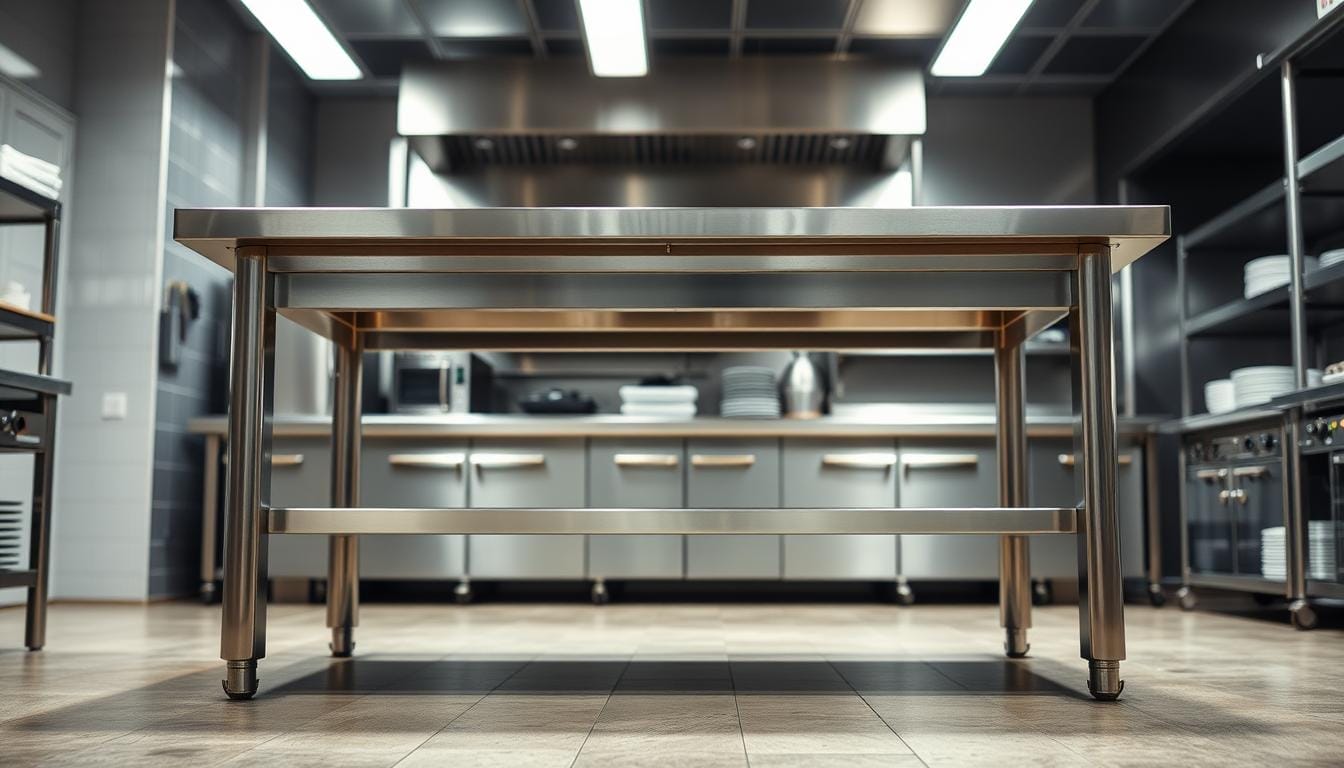
Looking for a single guide that clears the confusion around specs, materials, and on-site needs? This introduction frames the choices that matter: thickness by gauge, alloy selection, assembly style, and finishes.
The guide sets clear expectations: standard depths are 24″, 30″, and 36″ with lengths from 24″ to 144″, and full custom sizing when plans demand precision. 304 stainless steel is the standard for tops and frames; 316L tops are offered for corrosive settings like marine or lab spaces.
Buyers will learn construction choices: Fully Welded units arrive ready for immediate use, while Knock Down kits cut freight and ease site access. Gauge options—16 ga standard, plus 14, 12, and 11 ga upgrades—match durability to tasks.
Finish logic and spill control matter: Brushed, Matte, and Scratchy/swirled finishes handle appearance and wear, and V-style ledges or ledges with a 1/2″ return reduce drips. Spec-ready BIM/Revit files and measured PDFs speed project approvals.
Engineered for durability and efficiency in commercial and residential kitchens
A well-engineered prep surface transforms a cluttered station into a reliable production zone.
Designated prep zones streamline mise en place: separate areas for raw proteins, produce, and plating cut cross-contact and speed service. Durable tops stand up to frequent sanitizing and heavy equipment loads.
High-volume kitchens favor thicker gauge and fully welded frames to resist flex and prolong life. Specify 304 stainless steel tops for general foodservice; choose heavier gauges where mixing or large equipment is routine.
Home chefs and hobbyists gain the same benefits: a professional-grade unit adds a stable surface, simple cleaning, and long-term value in the garage or the kitchen.
- Mobility: lockable casters let caterers reconfigure for events.
- Safety: smooth finishes, coved sink corners, and drip-controlling edges reduce mess and hazards.
- Buyers: confirm doorway fit, counter height match, and assembly type for delivery.
Do you need a stationary centerpiece or a mobile island that adapts to prep, plating, and service?
stainless steel work table: what today’s buyers need to know
Choosing the right prep surface begins with clear, measurable performance criteria.
Standard height is 36″ to the top of the work surface; custom heights are common for ADA or appliance alignment. Buyers should list final uses before finalizing dimensions.
Select a flat top for island-style access or add a rear, left, or right backsplash from 1″ to 10″ to stop splashes against walls. Backsplash choice affects cleaning and drain routing.
Hygiene matters: choose seamless welds, nonporous finishes, and optional coved sink bowls to simplify sanitizing for daily food prep. These features speed health inspections and lower maintenance time.
- Load guidance: specify heavier gauge for mixers and grinders; lighter gauge suits staging and plating.
- Future-proofing: confirm space for drawers, shelves, or overshelves now—add-ons cost less when planned early.
- Documentation: measured PDF drawings and spec sheets shorten approvals for permitting and procurement.
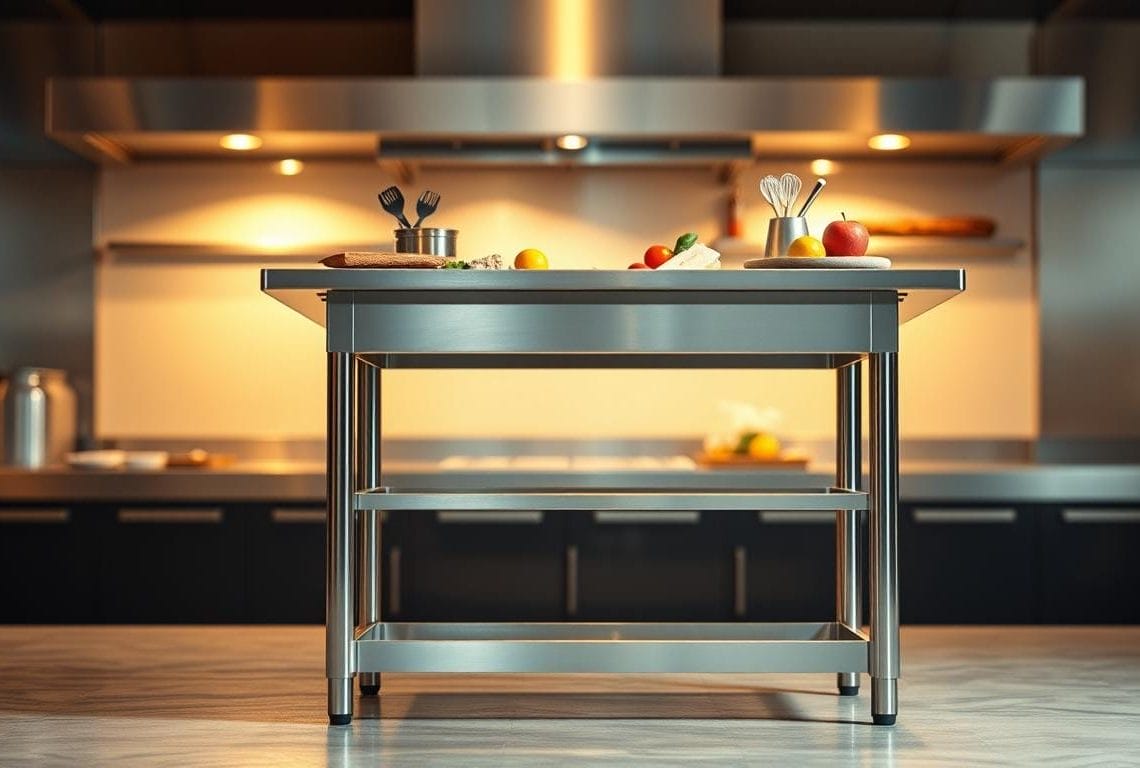
Plan one question: Will your prep include wet processes—washing produce or icing pastries—that benefit from a backsplash and drain-friendly design?
Choose your base: open base, cabinet base, and universal configurations
Base selection determines access, storage, and serviceability for any kitchen or shop. Start by mapping what must be within arm’s reach and how often it needs cleaning.
Open base options maximize clearance for tall gear and fast washdown. Choose a rear or center crossbar to support span and load. Add an undershelf that is adjustable with Knock Down assembly or fixed when Fully Welded for extra rigidity.
Cabinet bases offer organized storage: open front for quick access, sliding doors for narrow aisles, or a universal layout with hinged doors and 1–4 drawers for mixed needs. Mid-shelves (one or two) boost capacity; pick fixed for stability or adjustable for tool changes.

- Service openings: specify 12″x12″ back cutouts or full back panel removal for plumbing and power.
- Door swings: set hinge directions to fit aisles; sliding reduces clearance needs.
- Selection path: match base type to workflow, sanitation, and maintenance frequency.
Materials that matter: 304 stainless vs 316L alloy and tube framing
Alloy selection is a practical decision that balances durability, hygiene, and cost. Choose materials based on exposure: foodservice, labs, or marine settings demand different corrosion resistance.
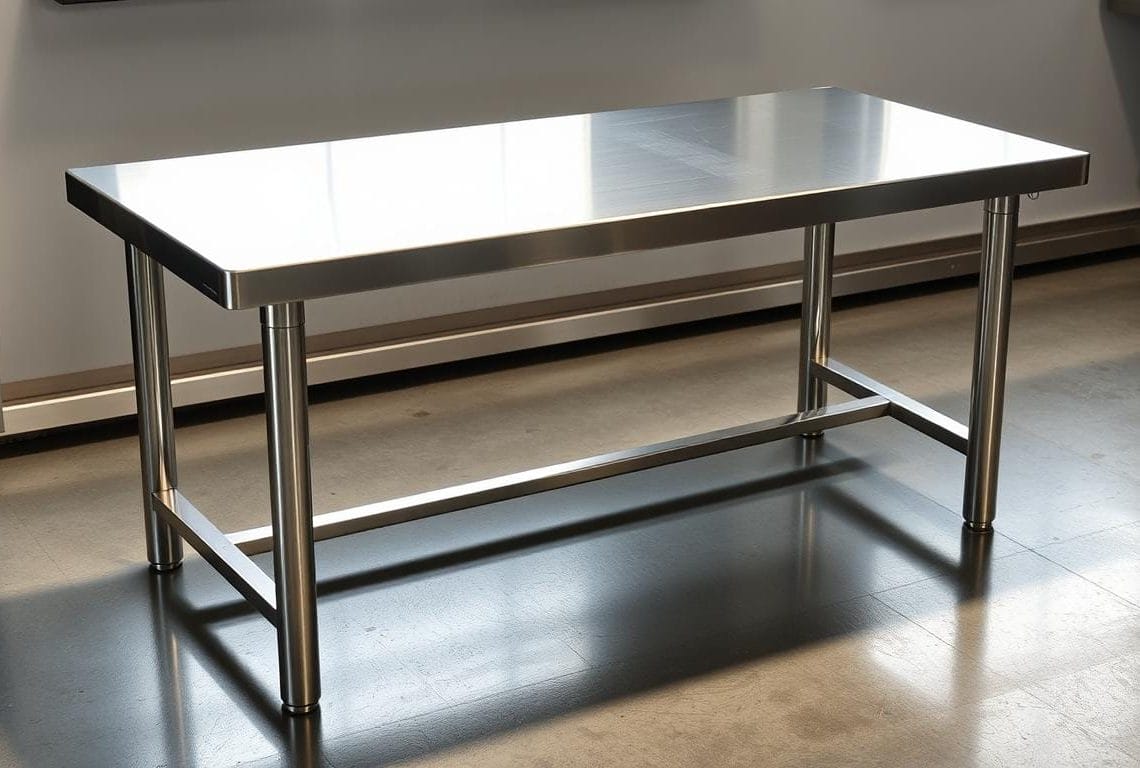
304 as the reliable baseline
304 stainless steel is the industry standard for commercial kitchens. It offers dependable food-contact durability and easy sanitation. Most buyers default to 304 for long service life and availability.
When to upgrade to 316L
Reserve 316L for salt air, harsh chemicals, or frequent sterilization. A 316L top reduces corrosion risk in marine galleys, labs, and certain healthcare zones while keeping cleaning simple.
Alloy strategy and structure
All models use 304 tubing, legs, and framing by default. The 316L option typically applies only to the table top to keep costs balanced.
- Pair gauge to use: heavier gauge with the chosen alloy in high-abuse zones improves dent resistance and flatness.
- Environment advice: restaurants and bakeries usually stay with 304; labs and galleys may justify a 316L top.
- Decide this: Will salt or chemicals hit the top? If yes, prioritize a 316L upgrade and retain 304 framing.
Gauge and construction: select the right table top thickness
Top gauge directly affects how a prep surface resists dents, vibration, and long-term warping.
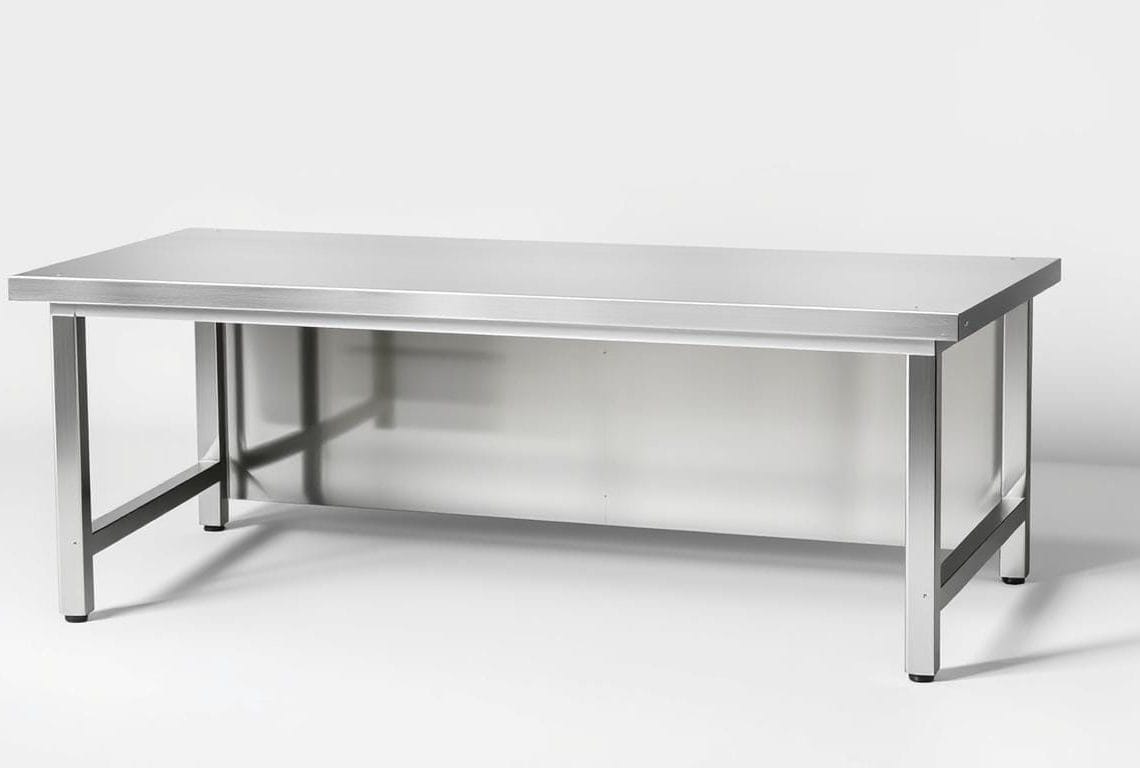
- 16G — .0598″ (standard for general prep and plating).
- 14G — .0747″ (about 25% thicker; better for frequent equipment use).
- 12G — .1054″ (≈76% thicker; suited for heavy impact and grinders).
- 11G — .1200″ (≈100% thicker; maximum stiffness and dent resistance).
Choose 16 gauge for light duty. Upgrade to 14 gauge when mixers or hot pans run daily. Pick 12 or 11 gauge for constant hammering or heavy machinery.
Assembly and shipping
Fully Welded units ship ready to use and give top-to-base rigidity that reduces racking and vibration.
Knock Down kits break down for lower freight and tight stair access; hardware and instructions included for on-site assembly.
- Start at 14G for mixed commercial use.
- Move to 12G/11G if heavy equipment runs daily.
- Pair heavier tops with cabinet bases or drawers to spread loads.
Thicker tops stay flatter in hot or wet cycles and cut vibration under mixers — improving precision and comfort during long shifts.
Sizes, heights, and edges: fit your floor plan and workflow
Fit the surface to the space: depth, length, and edge choices drive daily efficiency. Measure circulation, doorways, and reach zones before you specify dimensions.
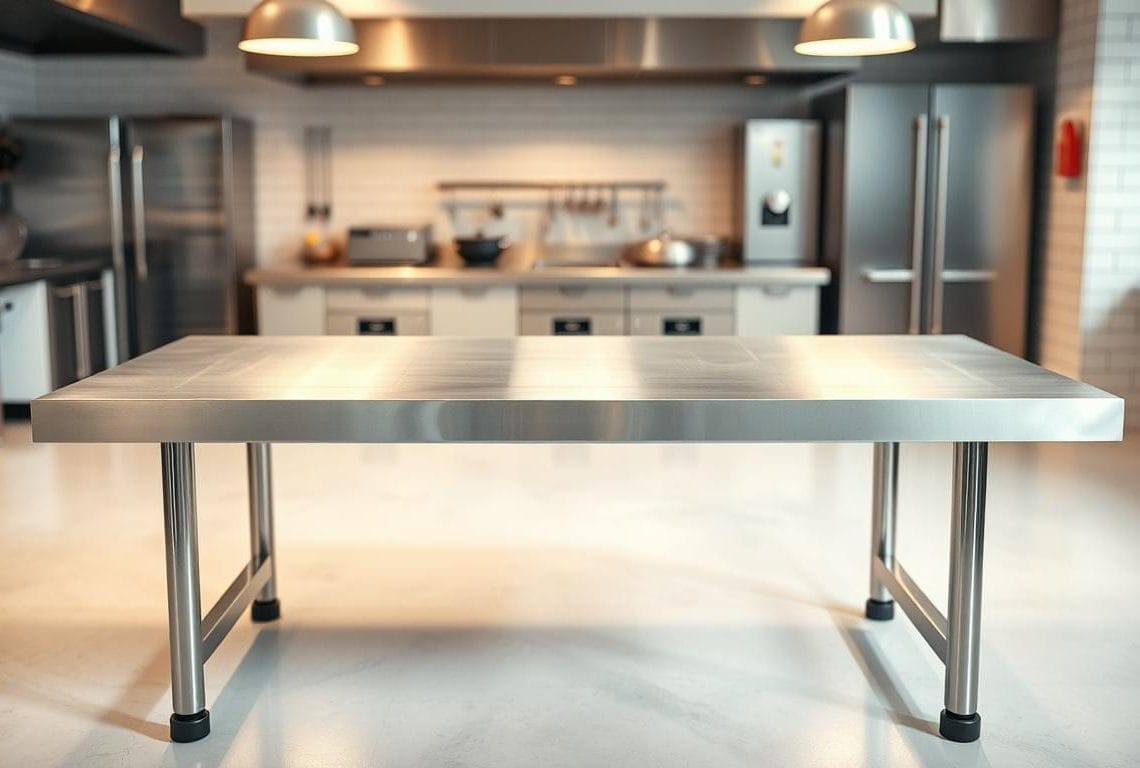
Standard sizes and custom options
Standard depths are 24″, 30″, and 36″. Widths run 24″–48″. Lengths span 24″–144″ to match walls or island runs.
Custom lengths and heights are available. The default height is 36″ to the top, but specify other heights for ergonomic stations or specialty equipment.
Top styles, backsplashes, and edge choices
Pick a flat top for island access or add a backsplash on the rear, left, or right from 1″ to 10″ to control splash and routing.
- Square edge: 1-1/2″ edge with a 1/2″ return for general prep.
- Marine edge: 1-1/2″ plus a 3/8″ no-drip lip and 1/2″ return for spill control.
- Bull nose: rounded front or selected sides for comfort and safer traffic flow.
Practical fit and finish tips
Coordinate edge choices with adjacent gear: round the front for wrist comfort; keep the rear square to seat against walls or a backsplash.
Measure twice: confirm door, elevator, and aisle clearances against your chosen width and length before fabrication. Consider gauge and top selection when planning heavy loads.
Smart storage, sinks, and mobility: configure your work table for the job
Practical choices—shelves, drawers, sinks, and casters—define how a prep zone performs. Decide on storage and plumbing up front to match daily tasks and cleaning cycles.

Undershelves, drawers, and kick plates
Optimize storage with an undershelf. Choose adjustable shelves with Knock Down kits or fixed shelves on Fully Welded frames for maximum rigidity.
Pick drawer style by duty: Type 1 has a removable front for fast cleaning. Type 2 adds stainless sides for heavy loads and greater rigidity.
Magnet-held kick plates hide cabinet undersides and remove quickly for sanitation and service access.
Integrated bowls, overshelves, and mobility
Specify single or double bowls welded into the top with 5/8″ coved corners for easy cleaning. Place bowls at the left, right, or center to suit flow.
Rear-mounted overshelves attach to a backsplash when present; mid-mounted units serve island stations and double-sided access.
Add 4″ swivel casters with brakes to shift units for events or cleaning. For beverage lines, include an urn trough with a removable grate to catch drips and speed cleanup.
For full sink-and-top solutions see stainless steel table and sink.
Surface finishes and food-safe details for stainless steel commercial use
Finish choice directly shapes daily cleaning, wear visibility, and inspection outcomes. Select a surface that fits the kitchen’s pace and sanitation plan.

Top finishes: brushed, matte, and scratchy/random swirl
Brushed offers directional satin lines that match appliances and show linear polishing. It is easy to wipe and looks uniform along grain.
Matte is non-directional and hides scuffs. Choose this in high-traffic prep zones to mask everyday wear and reduce rework.
Scratchy / Random Swirl provides a pre-aged, uniform patina. It accepts minor marks without obvious focal scratches and suits busy counters.
Grommet holes and polished top details
Install up to four 2″ grommet holes with rubber inserts to route cords for scales, mixers, or monitors. Place holes away from heavy chopping and splash zones.
- Match finishes across stations for a cohesive look with adjacent products and backsplash edges.
- Balance appearance and maintenance: non-directional finishes reduce visible wear patterns over time.
- Inspection readiness: smooth, cleanable surfaces and tidy cable routing speed audits.
Designed for commercial performance: restaurants, healthcare, labs, and more
Commercial operations demand reliability. A deliberate layout assigns raw, cooked, pastry, and plating zones to cut cross-contact and speed throughput.
Design for hygiene and speed: place a prep sink near protein stations and clear plating zones for final checks. Specify heavier gauge tops where daily heavy use occurs to limit deformation.
Clinical and lab settings: choose 316L tops when chemical resistance and rigorous sanitation are essential. These surfaces resist corrosion in hospitals, research labs, and marine galleys.
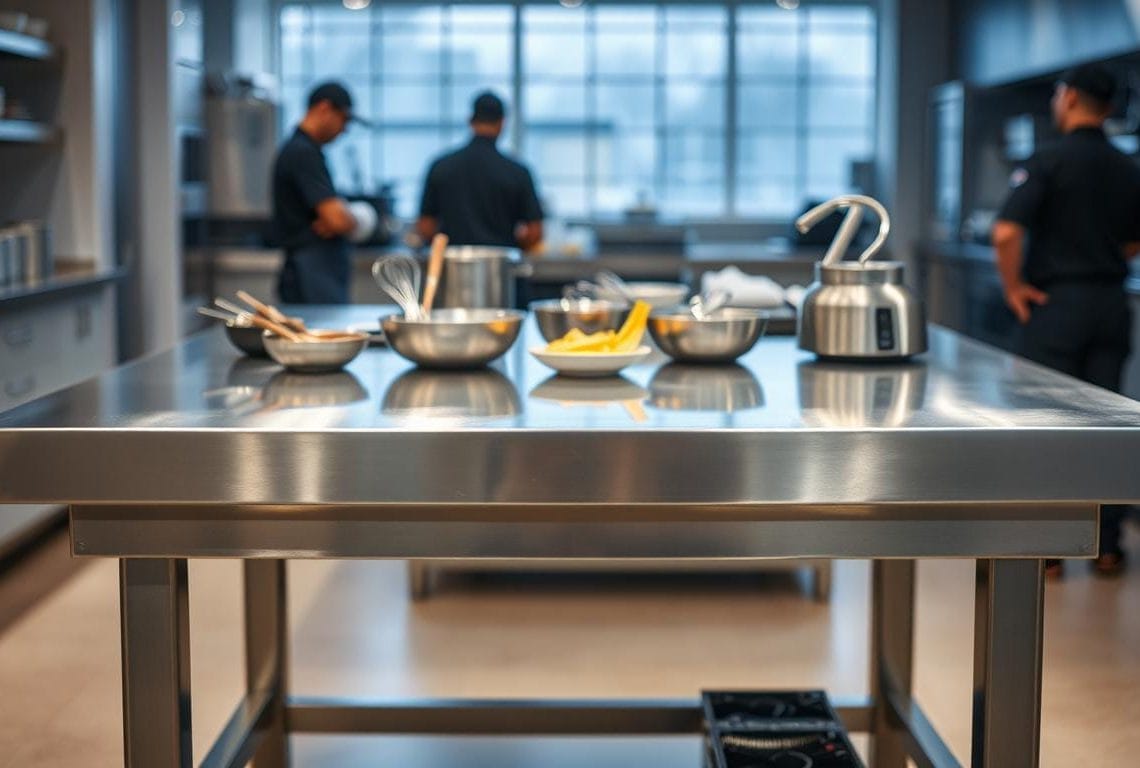
- Zoned workflows: assign stations to reduce cross-contact and simplify cleaning.
- Spec-ready files: download BIM/Revit families and get measured PDF drawings within one business day for approvals.
- Compliance support: detailed drawings lower change orders and align plumbing and equipment clearances with design teams.
- Plan accessories: add drawers, shelves, sinks, and casters at design time to avoid field modifications.
For a ready option with fast specs and models, see the 36×24 stainless steel work table to compare features and downloads.
Ready to design your work table? Build, save your table, and get a measured drawing
Complete the final options, save your project, and expect a detailed drawing for sign-off.
Configure size, alloy, gauge, base, storage, sinks, edges, finishes, and mobility—then use the Save Your Table feature to store the build for later review or team input. Give each job and work table a clear name to organize multiple locations or variations.
You will receive a measured PDF drawing within one business day after checkout. Review and approve the PDF: fabrication begins only after you sign off, ensuring dimensions and options match site conditions and workflow.
Iterate freely—adjust drawers, overshelves, or casters based on stakeholder feedback before release. This process protects quality and keeps projects on schedule for stainless steel commercial products and 304 stainless steel tops.