Did you know that over 40% of industrial equipment failures in high-heat environments stem from overlooked temperature limits in material selection? This startling statistic underscores why understanding thermal thresholds in alloys is non-negotiable for engineers and designers.
Every alloy has a unique thermal “sweet spot.” For example, austenitic grades like 304 or 316 excel in continuous high-heat scenarios, while ferritic variants such as 430 perform better in intermittent conditions. These differences hinge on alloy composition and its impact on corrosion resistance and structural integrity.
Ignoring these boundaries can lead to catastrophic outcomes. In chemical plants or aerospace systems, even minor deviations from recommended ranges may accelerate oxidation or weaken load-bearing components. Proper welding parameters further ensure joints withstand thermal stress without compromising safety.
This article unpacks technical data from recent studies, including oxidation patterns and mechanical behavior across temperature ranges. By analyzing how resistance to environmental factors interacts with heat endurance, professionals can make informed decisions for critical applications.
Fundamentals of Stainless Steel Temperature Performance
Modern alloys are engineered for diverse applications, from aerospace components to chemical processing tanks. Their performance hinges on precise composition and grade-specific properties that dictate heat resistance. Understanding these factors ensures materials maintain strength under thermal stress without succumbing to premature oxidation.
Overview of Stainless Steel Grades
Common grades like 304, 304L, and 304H demonstrate how slight variations alter thermal limits. Austenitic types (e.g., 304) contain 18% chromium and 8% nickel, ideal for continuous service up to 870°C. Ferritic grades, with lower nickel content, excel in moderate environments but face oxidation risks above 815°C.
Martensitic alloys prioritize hardness over heat tolerance. For example, 440C retains strength at 760°C but requires protective coatings in corrosive settings. Each grade’s properties align with specific industrial demands, balancing cost and durability.
Alloy Composition and Thermal Stability
Chromium forms a protective oxide layer, while nickel stabilizes crystal structures under thermal stress. The 304H variant’s higher carbon content (0.04-0.10%) boosts creep resistance at 500-800°C, per EN10095 standards. Conversely, 304L’s low carbon minimizes carbide precipitation during welding, preserving corrosion resistance.
Molybdenum additions in marine-grade alloys enhance oxidation resistance in chloride-rich environments. These compositional tweaks ensure materials withstand harsh service conditions, from furnace parts to exhaust systems.
Determining the Optimal stainless steel working temperature
Choosing the right alloy grade is pivotal for thermal applications. Engineers must balance continuous service limits with environmental factors like oxidation risks. Each variant’s chemical makeup creates distinct performance boundaries in extreme conditions.
Temperature Limits by Stainless Steel Type
Critical differences emerge when comparing common grades:
- Grade 304: Sustains 870°C continuously (ASM Handbook)
- 316 variants: Handle 925°C with added molybdenum
- Ferritic types: Max out at 815°C before oxidation accelerates
The 304H variant outperforms 304L in prolonged heat due to higher carbon content. This makes it ideal for furnace components but less suitable for welded joints.
Impact of Corrosion Resistance and Oxidation
Superior corrosion resistance directly enhances thermal endurance. Austenitic types dominate chemical processing systems where acidic vapors meet 500°C+ temperatures. In food-grade applications, 304’s chromium oxide layer prevents contamination during sterilization cycles.
Aerospace systems use specialized grades like 310 for jet engine parts. These alloys withstand 1150°C intermittent exposure while resisting fuel-related corrosion. Proper selection prevents catastrophic failures in mission-critical industries.
Industrial Applications and Thermal Considerations
What do rocket engine nozzles and milk pasteurization tanks have in common? Both rely on specialized alloys engineered to thrive under extreme thermal demands. Industrial sectors push materials to their limits, requiring precise adjustments in manufacturing and processing.
Applications in Chemical, Food, and Aerospace Industries
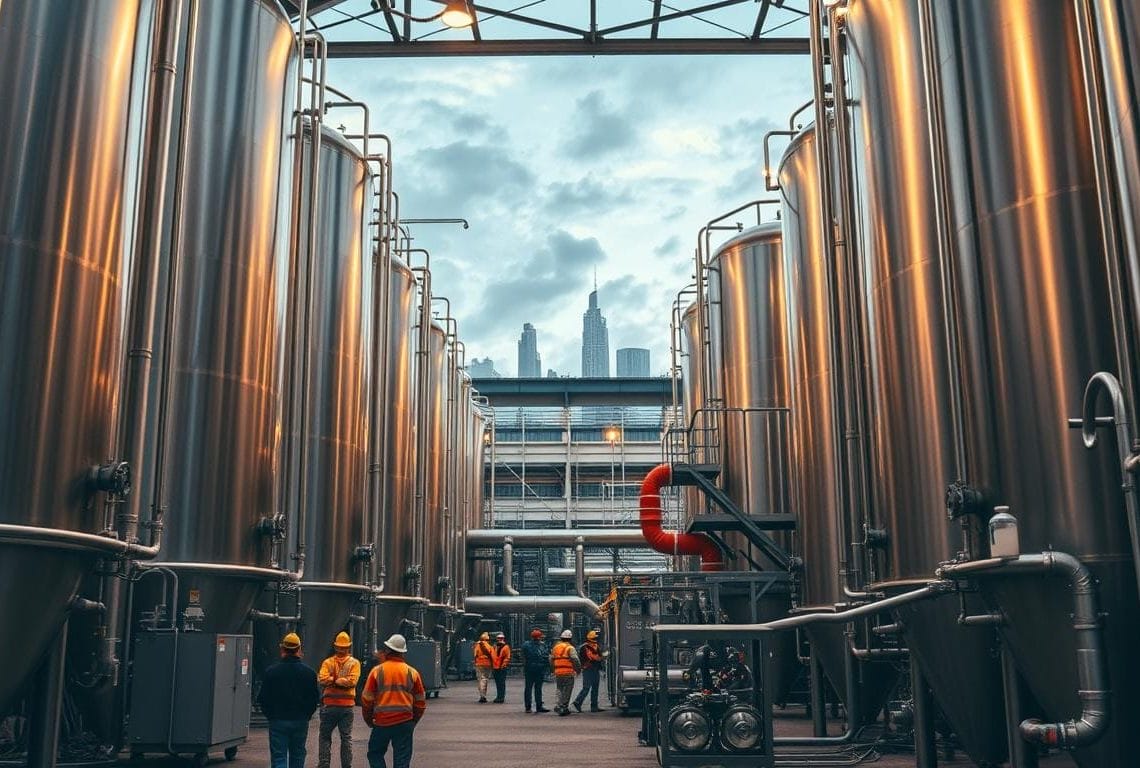
Chemical reactors handling corrosive acids at 600°C often use austenitic stainless variants. Their enhanced chromium content (up to 26%) forms a self-repairing oxide layer, crucial for high-temperature applications. Food processing lines leverage grades like 316L for sterilization equipment, where steam exposure meets strict hygiene standards.
Aerospace systems demand alloys that resist fuel combustion heat. Turbine blades made from nickel-rich variants endure 1150°C bursts while maintaining structural integrity. Each industry’s unique needs drive chemical composition tweaks and processing methods.
Effects of Heat Treatment and Annealing
Controlled heating cycles optimize performance. Annealing at 1040°C (per EN 10095) relieves internal stresses in stainless grades, restoring ductility. This annealed condition ensures components withstand thermal cycling in furnace parts or exhaust manifolds.
Precipitation-hardening treatments boost strength at elevated temperatures. For example, 17-4PH alloy gains 30% higher yield strength after aging at 480°C. Proper protocols prevent carbide formation that weakens oxidation resistance.
Cold Working and Mechanical Properties
Rolling or drawing at room temperature increases hardness but reduces elongation. Cold working austenitic types like 304 improves yield strength by 50%, ideal for pressure vessels. However, excessive deformation requires intermediate annealing to prevent cracking.
Balancing hot working and cold forming processes tailors materials for specific loads. Jet engine fasteners combine both techniques to achieve fatigue resistance at melting points nearing 1400°C. These methods ensure reliability where failure isn’t an option.
Final Perspectives on Temperature Factors and Material Performance
Engineers face critical decisions when selecting materials for extreme environments. Key factors like alloy content and heat treatment determine long-term durability. Proper thermal processing preserves corrosion resistance while maintaining structural integrity under stress.
Selecting the correct grade remains paramount. Variants like 316L excel in chloride-rich settings, while 304L suits welded assemblies. These choices directly impact product lifespan in industries ranging from aerospace to pharmaceuticals.
Fabrication methods also play a decisive role. Controlled annealing cycles restore ductility, while precise cold-working enhances yield strength. Such techniques ensure components withstand cyclic thermal loads without premature failure.
Balancing cost and performance requires technical rigor. Data-driven selection of widely used grades ensures reliability without overspending. This approach transforms theoretical material science into practical engineering solutions for modern challenges.