An 18 mesh stainless steel screen has 18 openings per linear inch in each direction. With the fine wire used for insect screening (about 0.011 in / 0.28 mm) each opening is roughly 1.1 mm wide, small enough to stop flies and mosquitoes while letting air and light through. That one number, though, only tells you half the story: the wire diameter decides how big the holes really are, how strong the screen is and how much air or liquid passes. This guide explains how stainless mesh is measured, gives a size chart from 4 mesh to 400 mesh with openings in inches, millimetres and microns, and covers the main mesh types (woven, welded, Dutch weave, wedge wire, perforated and expanded), which grade to buy, and how to choose mesh for insect and security screens, rodent proofing, gutter guards, filters, conveyor belts, fences and railings.
Quick answers
- What “mesh” means: the number of openings (or wires) per linear inch. 18 mesh = 18 per inch, not 18 per square inch.
- Opening size: opening = (1 ÷ mesh) − wire diameter. The same mesh count with thicker wire gives smaller holes.
- Insect screen: 18×16 or 18×14 mesh is the usual window screen; 20×20 keeps out smaller biting midges (“no-see-ums”).
- Mice and rats: openings of 6 mm (¼ in) or less, in wire stiff enough not to be chewed or pushed through, such as ¼ in (4 mesh) hardware cloth.
- Microns: about 100 mesh ≈ 150 µm, 200 mesh ≈ 75 µm, 400 mesh ≈ 38 µm (standard test sieve values).
- Grade: 304 for most indoor, food and general use; 316 near the sea, around pools and with salt or chlorides.
How stainless steel mesh is measured
Four numbers describe a woven mesh. Suppliers don’t always quote all of them, so it helps to know how they relate.
| Term | What it means | Why it matters |
|---|---|---|
| Mesh count | Openings per linear inch, counted from the centre of one wire. “18×16” means 18 per inch one way and 16 the other | Sets the spacing of the wires |
| Wire diameter | Thickness of each wire, in inches or mm | Thicker wire = stronger, stiffer screen with smaller openings and less airflow |
| Opening (aperture) | The clear gap between neighbouring wires | What actually stops insects, particles or debris |
| Open area | Percentage of the screen that is holes | Higher open area = more airflow, light and flow rate |
For a square plain-weave mesh:
- Opening (in) = 1 ÷ mesh count − wire diameter (in)
- Open area (%) = (opening ÷ (opening + wire diameter))² × 100
- 1 inch = 25.4 mm and 1 mm = 1,000 µm (microns)
Worked example, 18 mesh with 0.011 in wire: 1 ÷ 18 = 0.0556 in between wire centres. Subtract the wire: 0.0556 − 0.011 = 0.0446 in, which is 1.13 mm. Open area = (0.0446 ÷ 0.0556)² ≈ 64%. With heavier 0.017 in wire, the same 18 mesh has 0.0386 in (0.98 mm) openings and only about 48% open area.
Some suppliers describe coarse mesh by the size of the opening instead (“1 mm aperture”) and fine filter cloth by a micron rating. If a listing gives only a mesh count, ask for the wire diameter before you buy.
18 mesh stainless screen: specs and uses
18 mesh sits at the point where the openings are just small enough to keep out common flying insects. That’s why it is the classic window and door screening size, and why stainless 18 mesh is used where aluminium or fibreglass screens wear out too fast: coastal homes, pet doors, high-traffic doors, vents and fine guards.
| 18 mesh option | Typical wire | Opening | Open area | Typical use |
|---|---|---|---|---|
| 18×16 / 18×14 insect screen | 0.009–0.011 in (0.23–0.28 mm) | About 1.1–1.2 mm across the 18 direction, longer the other way | Roughly 65–75% | ✅ Window and door screens, porch enclosures |
| 18×18, 0.011 in wire | 0.28 mm | 0.0446 in / 1.13 mm | About 64% | ✅ Vents, guards, coarse strainers |
| 18×18, 0.017 in wire | 0.43 mm | 0.0386 in / 0.98 mm | About 48% | ✅ Sturdier sieves, sifting, industrial screens |
Don’t confuse an 18 mesh cloth with a “No. 18” test sieve. Test sieves are defined by their opening (No. 18 = 1.00 mm under ASTM E11), while a mesh cloth’s opening depends on the wire used.
Stainless steel mesh size chart (4 to 400 mesh)
The values below are calculated for square plain or twill weave using common wire diameters. Suppliers offer other wire sizes for most counts, so treat this as a guide and confirm the exact specification.
| Mesh | Wire diameter | Opening | Open area | Typical uses |
|---|---|---|---|---|
| 4 | 0.047 in / 1.19 mm | 0.203 in / 5.16 mm | 66% | ¼ in hardware cloth, rodent and bird proofing, guards, gravel and soil screening |
| 8 | 0.028 in / 0.71 mm | 0.097 in / 2.46 mm | 60% | ⅛ in hardware cloth, vents, compost and garden sieves, small-animal enclosures |
| 12 | 0.023 in / 0.58 mm | 0.060 in / 1.53 mm | 52% | Vent screens, seed and grain sieving, coarse strainers |
| 16 | 0.018 in / 0.46 mm | 0.045 in / 1.13 mm | 51% | Heavy insect screen, guards, filter support layers |
| 18 | 0.011 in / 0.28 mm | 0.045 in / 1.13 mm | 64% | Window and door insect screens, vents |
| 20 | 0.016 in / 0.41 mm | 0.034 in / 0.86 mm | 46% | Fine insect screen, kitchen strainers, sifting |
| 30 | 0.012 in / 0.30 mm | 0.021 in / 0.54 mm | 41% | Sieves, sand and soil testing, strainers |
| 40 | 0.010 in / 0.25 mm | 0.015 in / 0.38 mm (381 µm) | 36% | Kitchen sieves, flour sifting, coarse filtration |
| 50 | 0.009 in / 0.23 mm | 0.011 in / 0.28 mm (279 µm) | 30% | Sifting, brewing, liquid strainers |
| 60 | 0.0075 in / 0.19 mm | 0.0092 in / 0.23 mm (233 µm) | 30% | Fine sieves, fuel and oil strainers |
| 80 | 0.0055 in / 0.14 mm | 0.0070 in / 0.18 mm (178 µm) | 31% | Fine strainers, coffee and tea filters |
| 100 | 0.0045 in / 0.11 mm | 0.0055 in / 0.14 mm (140 µm) | 30% | Fine filtration, powder sieving |
| 120 | 0.0037 in / 0.094 mm | 0.0046 in / 0.12 mm (118 µm) | 31% | Fine filtration, cold brew and nut-milk filters |
| 150 | 0.0026 in / 0.066 mm | 0.0041 in / 0.10 mm (103 µm) | 37% | “100 micron” filters, powder and pigment sieving |
| 200 | 0.0021 in / 0.053 mm | 0.0029 in / 0.074 mm (74 µm) | 34% | Fine powders, lab sieving, hydraulic and fuel filters |
| 325 | 0.0014 in / 0.036 mm | 0.0017 in / 0.043 mm (43 µm) | 30% | Very fine powders, lab analysis |
| 400 | 0.0010 in / 0.025 mm | 0.0015 in / 0.038 mm (38 µm) | 36% | Very fine filtration and lab sieving |
For more sizes, up to 635 mesh and with several wire options, plus weights and formulas, see the stainless steel wire mesh screen sizes chart.
Above roughly 200 mesh, open area drops and the wire becomes very thin and easily damaged. For fine filtration that also needs strength, a Dutch weave (below) is often a better choice than a very high mesh count.
Mesh number to micron: standard test sieves
When someone asks for “200 mesh” in a lab, a mine or a powder plant, they usually mean the standard test sieve. These openings are fixed by ASTM E11 (and the matching ISO 3310-1 series), regardless of wire diameter.
| US sieve No. | Opening | US sieve No. | Opening |
|---|---|---|---|
| 4 | 4.75 mm | 60 | 250 µm |
| 8 | 2.36 mm | 80 | 180 µm |
| 10 | 2.00 mm | 100 | 150 µm |
| 16 | 1.18 mm | 120 | 125 µm |
| 18 | 1.00 mm | 140 | 106 µm |
| 20 | 850 µm | 200 | 75 µm |
| 30 | 600 µm | 270 | 53 µm |
| 40 | 425 µm | 325 | 45 µm |
| 50 | 300 µm | 400 | 38 µm |
So a “100 micron” stainless screen is slightly finer than a No. 140 sieve (106 µm). In woven cloth it is typically around 150 mesh, or a Dutch weave.
“¼ inch” and “⅛ inch” mesh
For hardware cloth, “¼ inch mesh” normally means 4 openings per inch, so the wires are ¼ in apart centre to centre and the clear hole is a little smaller (about 0.20 in / 5 mm with typical wire). “⅛ inch mesh” is 8 mesh, with holes of roughly 2.5 mm. If the exact gap matters, for rodents for example, check whether the size quoted is the opening or the wire spacing.
Types of stainless mesh and screen
“Mesh” covers several quite different products. The right one depends on whether you need fine filtering, strength, a rigid panel or something flexible.
| Type | How it’s made | Strengths | Typical uses |
|---|---|---|---|
| Plain weave | Each wire passes over one, under one | The standard: even, square openings | Insect screen, sieves, strainers, most rolls |
| Twill weave | Over two, under two | Allows heavier wire for the mesh count, so stronger | Fine filter cloth, heavy-duty sieves |
| Dutch weave (plain, twill, reverse) | Thick wires one way, thin wires packed tightly the other | Very fine, strong filtration; rated in microns rather than mesh | Hydraulic, fuel and polymer filters, extruder screens |
| Crimped wire mesh | Heavy wire pre-crimped (wavy) before weaving so it locks in place | Rigid, stays square under load | Quarry and aggregate screens, guards, infill panels, heavy-duty mesh |
| Welded mesh | Straight wires welded at every crossing | Stiff panels that can be cut without unravelling | Fencing, enclosures, shelving, concrete and machine guards |
| Knitted mesh | Single wire knitted in interlocking loops | Very flexible, springy | Mist eliminators (demister pads), gaskets, EMI shielding, scourers |
| Rope (cable) mesh | Stainless wire rope joined with ferrules into diamond openings | Strong, flexible, almost invisible from a distance | Balustrade infill, zoo and aviary enclosures, green walls, safety netting |
| Wedge wire (profile wire) | V-shaped wires welded to support rods with precise slots | Slots widen inward so particles don’t wedge; easy to backwash | Water wells, water and wastewater intakes, food processing, mining screens |
| Perforated sheet | Holes punched in stainless sheet, or in thicker stainless plate for heavy-duty punch plate | Smooth, rigid, easy to clean | Drains, food trays, speaker grilles, sieves, cladding |
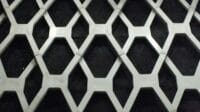
| Expanded metal | Sheet slit and stretched into diamonds, no waste | Strong and stiff for its weight; one piece with no joints | Walkways, security grilles, facades (stainless expanded metal) |
Which stainless grade for mesh?
Most stainless mesh is woven from 300-series wire made to ASTM A478 (stainless weaving and knitting wire). The grade matters most outdoors and in wet or salty environments. Our guide to stainless steel grades goes deeper.
| Grade | Use in mesh |
|---|---|
| 304 / 304L | ✅ The default for insect screens, food and kitchen strainers, sieves, baskets and indoor or inland outdoor use. 304L is the low-carbon version for parts that are welded (304 vs 304L) |
| 316 / 316L | ✅ Coastal and marine sites, pool enclosures, chemical and pharmaceutical filtration, anywhere chlorides or de-icing salts are present. The molybdenum resists pitting (304 vs 316, 316 vs 316L) |
| 310S, 314 | ✅ High-temperature use: furnace and heat-treatment conveyor belts, kiln and burner screens |
| 2205 duplex | ✅ Stronger and more resistant to chloride stress corrosion than 316; used for demanding filtration and offshore applications (2205 vs 316) |
| 430 | ⚠️ Cheaper, magnetic ferritic grade. Fine for dry indoor use and magnetic separation, but rusts sooner outdoors (430 vs 304) |
| 201 / 202 | ⚠️ Low-nickel grades found in some budget mesh; less corrosion resistant than 304 (201 vs 304) |
A magnet is not a reliable grade test for mesh. Austenitic 304 wire in particular becomes slightly magnetic when it is cold-drawn and woven, so a mesh that attracts a magnet a little may still be 304 (see stainless steel and magnets). Ask for a mill certificate if the grade matters.
Choosing mesh for common jobs
Insect screens and security screens
- Insect screen: 18×16 or 18×14 stainless with fine wire (about 0.009–0.011 in) gives good visibility and airflow. Use 20×20 if tiny biting midges are a problem, accepting a slightly darker screen and less airflow.
- Pet-resistant screen: the same mesh counts in heavier wire resist claws better than aluminium or fibreglass.
- Security screens: these use much heavier stainless wire (often around 0.8–1 mm) woven at about 10–11 mesh, tensioned and clamped into a strong aluminium or steel frame. The mesh alone does not make a security screen; the frame, the clamping of the mesh edge and the locks are just as important. In Australia these products are tested to AS 5039; elsewhere, look for the relevant local standard.
- Grade: 316 within a few kilometres of the sea, 304 elsewhere.
Rodent and bird proofing
Mice can squeeze through gaps of about 6 mm (¼ in), and rats through gaps of about 12 mm (½ in). For vents, weep holes, crawl-space openings and gaps around pipes:
- Use mesh with openings of 6 mm (¼ in) or less; ⅛ in (8 mesh) is safer against small mice.
- Choose wire stiff enough not to be bitten through or pushed aside, about 0.6 mm (0.025 in) or heavier for mice and heavier still where rats are the problem. Fine insect screen is too soft.
- Fix it with stainless screws and washers or staples, overlapping the opening by at least 25 mm on every side, and seal the edges. Rodents work at loose edges.
- For gaps around pipes and cables, pack with stainless or copper wool and seal over it.
Gutter guards
“Micro mesh” gutter guards use fine woven stainless (openings well under 1 mm) on a rigid perforated or expanded frame. They keep out leaves, pine needles and most roof grit, but fine debris and pollen can collect on top, so they still need an occasional brush-off. Stainless lasts much longer than plastic or aluminium mesh, especially under trees and near the coast. Make sure the frame is supported so the mesh can’t sag and pond water.
Filters, strainers, discs and baskets
- Liquid strainers and pre-filters: 20–60 mesh for coarse debris, 80–200 mesh for fine sediment.
- “100 micron” and finer: about 150 mesh in plain weave, or a Dutch weave when the screen also needs strength or carries pressure.
- Coffee, tea and brewing: reusable stainless coffee filters, hop spiders and brew-in-a-bag screens are usually in the 100–400 µm range. Finer mesh gives a cleaner result but drains more slowly and clogs sooner. Use 304 or 316, both standard food-contact grades (see is stainless steel safe for food?).
- Mesh discs: cut circles of mesh, often with a rolled or welded rim, used as screen packs in plastic extruders, filter cartridges and sieve inserts. Specify diameter, mesh, wire and whether the edge is bound.
- Mesh baskets: welded wire or woven mesh baskets for parts washing, frying, sterilisation and pickling or passivation. 316 is the safer choice when baskets go through acid baths.
Conveyor belts
Stainless wire mesh belts carry food through ovens, fryers, freezers and washers, and parts through furnaces, because they tolerate heat, washdown and cleaning chemicals. Common styles are balanced weave (spiral wires linked by cross rods), flat-wire belts with large open area, and chain-edge belts. 304 and 316 suit food processing and washers; 310S or 314 suits furnace belts. Belt choice depends on load, temperature, product size and drive, so it is normally specified with the belt maker.
Fences, railings, nets and enclosures
- Fence mesh: welded stainless panels or chain-link (diamond) mesh for long life where galvanised fencing would rust, such as on the coast or around pools (stainless vs galvanized).
- Railing and balustrade infill: stainless rope mesh, woven mesh panels or welded mesh in a stainless handrail frame. Under US residential code, guard openings must not let a 4 in (102 mm) sphere pass; other countries have similar rules, so check the local building code for guard height and openings.
- Diamond mesh and stainless “net”: rope mesh made from stainless wire rope is used for zoo and aviary enclosures, fall protection, climbing plant supports and bird netting. Aperture sizes typically range from a few centimetres to well over 10 cm.
Architectural mesh, curtains and flexible mesh fabric
Woven architectural mesh (flat-wire or cable weaves) is used for facades, sunshades, ceilings, parking-garage screens and room dividers. Ring mesh (chainmail) and coil curtains hang like fabric and are used as decorative curtains and dividers. Fine “mesh fabric” and flexible mesh are simply thin-wire plain or twill weaves that can be shaped, sewn into filter bags or formed over moulds. Mesh watch bands and fitness-tracker straps (“Milanese” bands) are another small-scale example, usually made in 316L.
How to choose stainless mesh: step by step
- Define the job: what must be stopped (insects, rodents, leaves, particles of a given size) and what must pass (air, light, water, product).
- Pick the opening first, in mm or microns, then find mesh and wire combinations that give it.
- Pick the wire diameter for strength: thicker for impact, chewing, pets or load; thinner for visibility, airflow and flow rate.
- Check the open area if airflow or flow rate matters.
- Choose the type: woven for screens and filters, welded or crimped for rigid panels, Dutch weave for fine filtration under pressure, expanded or perforated sheet for walk-on or rigid parts.
- Choose the grade: 304 by default, 316 near salt or chlorides, heat-resistant grades for high temperatures.
- Specify it fully: mesh count, wire diameter, weave, grade, roll width and length, or cut size and edge finish.
Cutting, installing and joining stainless mesh
- Cutting: fine and medium mesh cuts with heavy scissors or aviation (tin) snips. Heavy wire needs bolt cutters or an angle grinder with a thin cutting disc kept for stainless only, so carbon steel particles don’t contaminate it (see cutting stainless steel).
- Edges: cut mesh has sharp wire ends. Wear gloves, fold the edge over, or cover it with a U-channel edge trim or a frame.
- Fixing: use stainless fasteners. Galvanised or plain steel staples and screws rust and stain the mesh. In wet or salty conditions, isolate stainless from aluminium frames (with gaskets or the frame’s spline system) to limit galvanic corrosion of the aluminium.
- Joining: overlap and lace with soft stainless tie wire (sizes and grades in our stainless steel wire guide), clip with hog rings, or weld heavier mesh with TIG or spot welding (see our stainless welding guide). Clean weld discoloration afterwards so it doesn’t rust.
- Screens: stainless insect mesh is stiffer than fibreglass, so tension it evenly with the spline tool and work from one corner to avoid waves.
Cleaning stainless mesh and preventing rust
- Screens: brush off dust, then wash with warm water and mild detergent using a soft brush, and rinse. On the coast, rinse a few times a year to remove salt.
- Filters and fine mesh: backflush with water, soak in warm detergent or a suitable degreaser, and use an ultrasonic bath for very fine cloth. Don’t scrub fine mesh with wire brushes; it distorts the openings.
- Avoid: chlorine bleach and hydrochloric (muriatic) acid, which attack stainless, and carbon-steel brushes or steel wool, which leave iron particles that rust.
- Brown spots: usually surface staining from salt, iron particles or welding, not the mesh rusting through. Remove them with an oxalic-acid cleaner or a stainless rust remover, rinse well, and switch to 316 if it keeps coming back. Our guide to why stainless steel rusts explains the causes, and how to clean stainless steel covers general care.
- Passivation: mesh that has been cut, welded or handled with steel tools can be passivated to restore its protective surface (see passivation of stainless steel).
Frequently asked questions
What does 18 mesh mean?
18 openings (or wires) per linear inch in each direction. It is not per square inch. The actual hole size depends on the wire: about 1.13 mm with 0.011 in wire, or 0.98 mm with 0.017 in wire.
What is the difference between 16 mesh and 18 mesh?
16 mesh has 16 openings per inch, so the wires are spaced further apart (0.0625 in vs 0.0556 in). With the same wire, 16 mesh has larger holes and more airflow. 16 mesh is often supplied in heavier wire for strength, while 18 mesh with fine wire is the standard insect screen.
How do I convert mesh to microns?
Calculate the opening: (25,400 ÷ mesh count) − wire diameter in microns. For example, 200 mesh with 0.053 mm (53 µm) wire: 25,400 ÷ 200 = 127 µm, minus 53 = 74 µm. For standard test sieves, use the fixed ASTM E11 values instead (No. 200 = 75 µm).
Is stainless steel mesh better than aluminium or fibreglass screen?
It is stronger, more resistant to pets, heat and fire, and lasts longer, especially near the sea or in direct sun, where fibreglass becomes brittle and aluminium corrodes. It costs more, is stiffer to install, and very fine stainless insect mesh can look slightly darker. For most homes fibreglass is adequate; stainless pays off in harsh, coastal or high-wear locations.
Does stainless steel mesh rust?
Good-quality 304 or 316 mesh doesn’t rust through in normal use, but it can show brown surface staining from salt, chlorides or iron contamination. Fine mesh has a lot of surface area and very thin wire, so 316 is worth it near the coast or pools.
What size mesh keeps out mice?
Openings of 6 mm (¼ in) or smaller, such as 4 mesh hardware cloth, in wire stiff enough not to be chewed or pushed aside. 8 mesh (⅛ in) gives a safety margin for small mice. Fix all edges firmly so they can’t be lifted.
Is woven or welded mesh stronger?
For the same wire, welded mesh is stiffer and holds its shape when cut, which suits panels, fences and guards. Woven mesh, especially crimped heavy wire, handles abrasion and vibration better and is the only practical choice for fine screens and filters.
Last updated: November 2026. Openings and open areas are calculated from the mesh counts and typical wire diameters shown; suppliers offer other wire sizes, so confirm the exact specification before ordering. Test sieve openings follow ASTM E11. Rodent, railing and security-screen guidance is general; check local building codes and the product’s own standards.
Keep reading


Sponsored